18 November 2026
How to Choose the Right Buggy for Dubai's Desert
Presented by @mybuggydubailab
Understanding What a Desert Buggy Needs to Handle
Dubai's desert is not a single surface. You will find soft, shifting sand in the high dunes near Al Awir, compacted gravel in the wadis, and patches of hard salt flats around the inland areas. A buggy that works well on one terrain can struggle or become dangerous on another. Before you start comparing models, think about where you plan to ride most often. If you expect to spend most of your time on the deep red dunes of the Liwa area, you need a buggy with a wide track and low ground pressure. If you plan to explore a mix of sand and rocky trails, a more versatile machine with adjustable tyre pressure and a robust suspension will serve you better.
Another factor is the climate. Summer temperatures in the desert can exceed 50°C, and the sand itself can get hot enough to melt plastics and degrade rubber seals. A buggy designed for cooler climates may suffer from overheating, perished hoses, or a failing cooling system. Look for models that mention high-temperature tolerance, such as reinforced radiator cores or upgraded fans. Many off-road vehicles sold in Dubai are adapted for heat, but not all. Ask the rental or purchase provider about the buggy's heat management. If they cannot give a clear answer, it is worth confirming with whichever business you choose what steps they take to keep their equipment running in the local summer.
Step 1: Decide Between a Guided Tour and a Self-Drive Rental
The first fork in the road is whether you want a guided desert safari experience or a self-drive buggy rental. Guided tours usually include a lead vehicle, a set route, and often a support crew. This option is good if you are new to dune bashing or unfamiliar with reading the desert. The guide handles navigation and can pull you out if you get stuck. On the downside, you follow a schedule and cannot explore freely.
Self-drive rentals give you the buggy for a set period, typically half a day or a full day, and you head out on your own or with a group. This offers more freedom but demands that you understand desert driving. Getting stuck in soft sand without recovery gear can ruin a trip. Some places offer a mix: a briefing and a map, then you go solo. Whichever route you take, check what recovery equipment comes with the buggy. A shovel, a tow rope, and a tyre pressure gauge are basic items that can save you hours of trouble.
Step 2: Check the Buggy's Safety Features
Safety in a desert buggy comes down to a few key elements. The most important is the rolling cage. This is the metal frame that surrounds the driver and passenger. It should be made of welded steel or aluminium, not bolted together. A bolted cage can loosen over time and may not hold in a roll. Look for a cage that extends above the occupants' heads and has cross-bracing behind the seats. Some cheaper buggies have a cage that looks sturdy but uses thin tubing. Ask about the wall thickness of the tubing. A cage made from 1.5-inch diameter, 14-gauge steel is a good standard.
Another critical item is the safety harness. A lap belt is not enough when you are bouncing over dunes. A five-point harness that straps over both shoulders, around the waist, and between the legs keeps you secure. Check that the harness is adjustable and that the buckles work smoothly. In a crash, a jammed buckle can trap you inside the buggy. Also, make sure the buggy has a kill switch, sometimes called a tether or an emergency stop. This is a cord attached to the driver. If the driver is thrown from the seat, the cord pulls and cuts the engine, stopping the buggy from continuing without control.

Finally, inspect the brake system. Hydraulic disc brakes are standard on most modern buggies. They should feel firm when you press the pedal, not spongy. If you are renting, test the brakes on a flat area before heading into the dunes. A buggy with worn brake pads can be dangerous on steep descents. If the brakes feel soft, do not take the buggy out; ask for a different one.
Step 3: Evaluate the Engine and Drive System
The engine is the heart of the buggy. Most desert buggies use either a petrol engine or a diesel engine. Petrol engines are lighter and rev higher, which helps when you need to crest a dune quickly. Diesel engines offer more torque at low speeds and are more fuel-efficient, but they are heavier. For pure dune bashing, a petrol engine with around 150 to 200 horsepower is a common sweet spot. It gives enough power to climb steep sand without being so heavy that it sinks.
The drive system matters too. A four-wheel-drive buggy is essential for soft sand. Two-wheel-drive buggies will struggle on anything but hard-packed gravel. Also, look at the transmission. A continuously variable transmission (CVT) is common on lighter buggies and offers smooth acceleration. A manual gearbox gives more control but requires practice to shift smoothly while bouncing over dunes. For a beginner, a CVT is easier to manage.
One local option is Buggy Adventure Dubai | ATV Quad Bike Tours & Desert Safari Dubai. While researching, you may come across websites that list different buggy models and their specs. A useful resource for comparing features is dunebuggyadventure.co, which provides detailed information on various buggy configurations and their suitability for Dubai's terrain.
Step 4: Consider the Tyres and Suspension
Tyres are your only contact with the ground. In soft sand, wide tyres with a low profile and deep tread help the buggy float rather than dig in. Some buggies come with paddle tyres, which have large, spaced-out lugs designed to push sand backwards. These work well for straight-line dune climbing but can make the buggy unstable on corners. For general use, a balanced all-terrain tyre is a better choice.
Tyre pressure is critical. Most desert drivers lower the pressure to around 8-12 psi for sand driving. This increases the tyre's footprint and improves traction. However, running too low a pressure can cause the tyre to spin on the rim, damaging the valve stem. A good buggy setup includes bead-lock rings that prevent the tyre from slipping off the rim at low pressures. Ask whether the buggy has bead-lock rims.
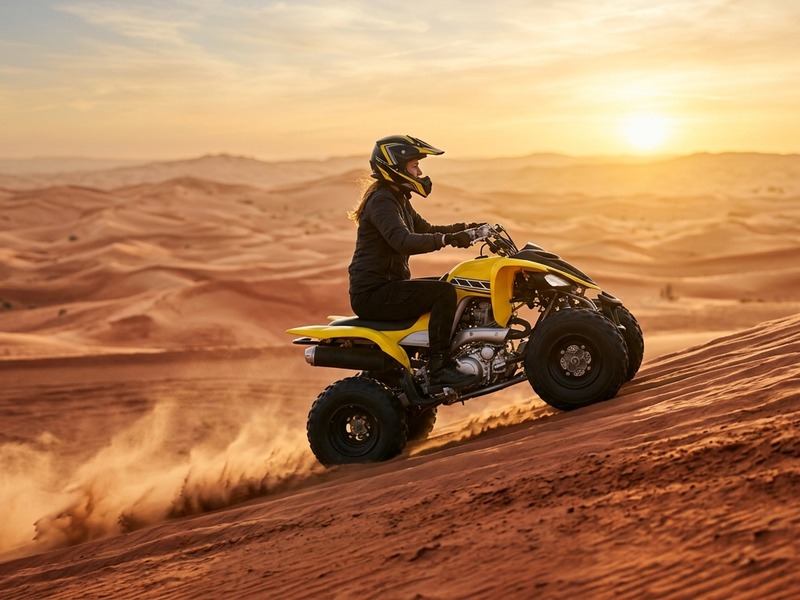
Suspension quality directly affects comfort and control. A buggy with long-travel suspension, around 10 to 12 inches of travel, handles big bumps and steep dune drops much better than a short-travel system. Look for adjustable shocks that allow you to stiffen or soften the ride depending on the terrain. Air-cooled shocks are common, but oil-cooled shocks perform better in sustained high-speed runs because they dissipate heat more effectively.
Step 5: Assess the Comfort and Space Inside the Cockpit
You may spend several hours in the buggy. A cramped cockpit with poor seat padding can make the experience unpleasant. Sit in the buggy before you commit. Check the seat height, the distance to the pedals, and the position of the steering wheel or yoke. Your knees should not hit the dashboard, and you should be able to reach all controls without stretching. The seat should have enough padding to absorb vibration. Some buggies offer a suspension seat, which is a seat mounted on a spring or air shock that moves independently from the frame. This reduces the jolts transmitted to your spine over bumpy terrain.
Storage is another point. A small compartment for water, a phone, and a map is useful. Many buggies have a mesh pouch behind the seat or a small lockable box between the seats. If you plan to ride for a full day, having room for a hydration pack or a few bottles of water is important.
Step 6: Review the Rental or Purchase Agreement Carefully
Whether you rent or buy, the terms matter. For rentals, check the damage policy. Some companies charge for every scratch or dent, while others have a standard wear-and-tear clause. Ask about the excess, which is the amount you pay if you damage the buggy. Also, find out what happens if you break down in the desert. Does the company provide recovery? Is there a call-out fee? Many operators offer a support vehicle on standby, but not all.
If you are buying a buggy, check the warranty. Most new buggies come with a one-year warranty on parts and labour. Look for a warranty that covers the engine, transmission, and frame. Also, ask about the availability of spare parts. Some buggy brands have a local dealer network in Dubai, which makes sourcing parts easier. Others require ordering from overseas, which can take weeks. For a machine that you will use regularly, local parts support is a big advantage.
Another resource that can help you compare different options and read user reviews is dunebuggyadventure.co. It covers a range of buggy models and offers practical advice on what to look for when inspecting a buggy in person. Using such a site alongside your own test drive can give you a clearer picture of what suits your needs.
Making Your Choice
Choosing the right buggy for Dubai's desert comes down to matching the machine to the terrain, the driving style, and the level of support you expect. Start by deciding whether a guided tour or self-drive rental fits your plan. Then check the safety features: a solid rolling cage, a five-point harness, a kill switch, and good brakes. Evaluate the engine and drive system for the type of sand you will ride on. Consider the tyres and suspension for comfort and control. Sit in the buggy to check the fit. Finally, read the agreement carefully to avoid surprises. Taking these steps one at a time will lead you to a buggy that is safe, comfortable, and fun to drive in the dunes.
Buggy Adventure Dubai | ATV Quad Bike Tours & Desert Safari Dubai, located at Regalia Tower, Ground Floor Office No. 5 - Business Bay - Dubai - United Arab Emirates, is a local business that can provide further information on buggy options and desert tours.